
Category: Uncategorized
‘McCarthyism’
Link to promotional film for ‘McCarthyism’
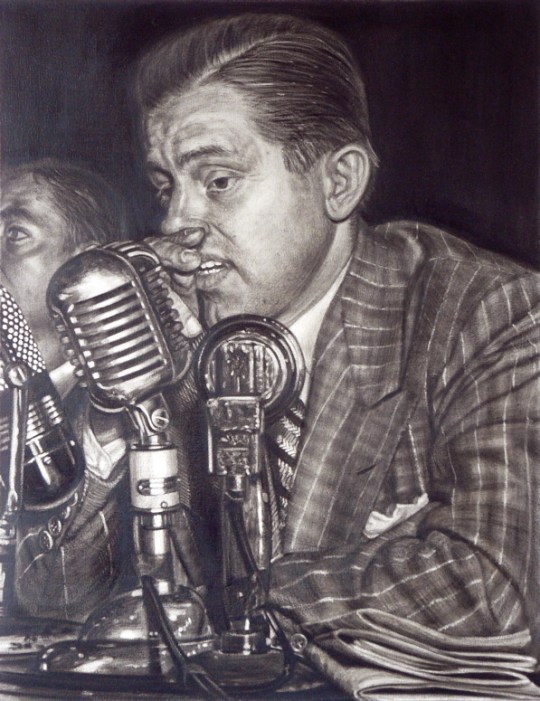
‘Dmytryk on Stand’ oil on canvas 79 x 61 cm 2013
McCarthyism
February 4th – 28th 2016
Contemporary Art Space Chester
Kingsway Buildings, University of Chester CH2 2LB.
Curated by Mike Chavez-Dawson
Imagine a time when immigration was seen as a potential source of radicalism and sectors of the population were regarded as a dire threat to the State. At the start of the cold war in the USA, the communist threat was perceived as imminent and even Hollywood stars were not above suspicion.
McCarthyism is an exhibition of paintings by David Gledhill based on American press photographs of the ‘House Un-American Activities Committee’ hearings of the 1940’s and 50’s. The committee was dedicated to the exposure and elimination of the communist threat in every branch of American life. Trades unionists, teachers, secretaries, janitors, artists, actors, writers and directors were amongst those forced out of their jobs.
Senator Joseph McCarthy of Wisconsin did not sit on the committee himself, but his virulently anti-communist speeches of the early 1950’s gave rise to the term ‘McCarthyism’ which has become synonymous with the ‘red scare’ of the post-war years in the USA.
The source photographs used for the project were bought online from Detroit and Chicago newspaper archives using the search terms ‘communism’ and ‘photograph’. The backs of the photographs are covered with editor’s remarks and filing references which reflect general attitudes to the perceived communist threat, and these have been used for the titles of the paintings.
At a time of increasing surveillance and renewed talk of the ‘enemy within’, McCarthyism is a timely reminder of the dangers implicit in the narrowing of political life, and the risks to civil liberties of scapegoating minority groups in society.
McCarthyism
February 4th – 28th 2016
Contemporary Art Space Chester
Kingsway Buildings, Chester, Cheshire.

‘Leo Turner and Attorney Belford Lawson at a Communist Hearing in 1959’ Oil on Canvas 122 x 153 cm 2013
‘Facilitators, Perpetrators and Victims’ New work by David Gledhill at Rogue Open Studios 24th-25th October 2015.
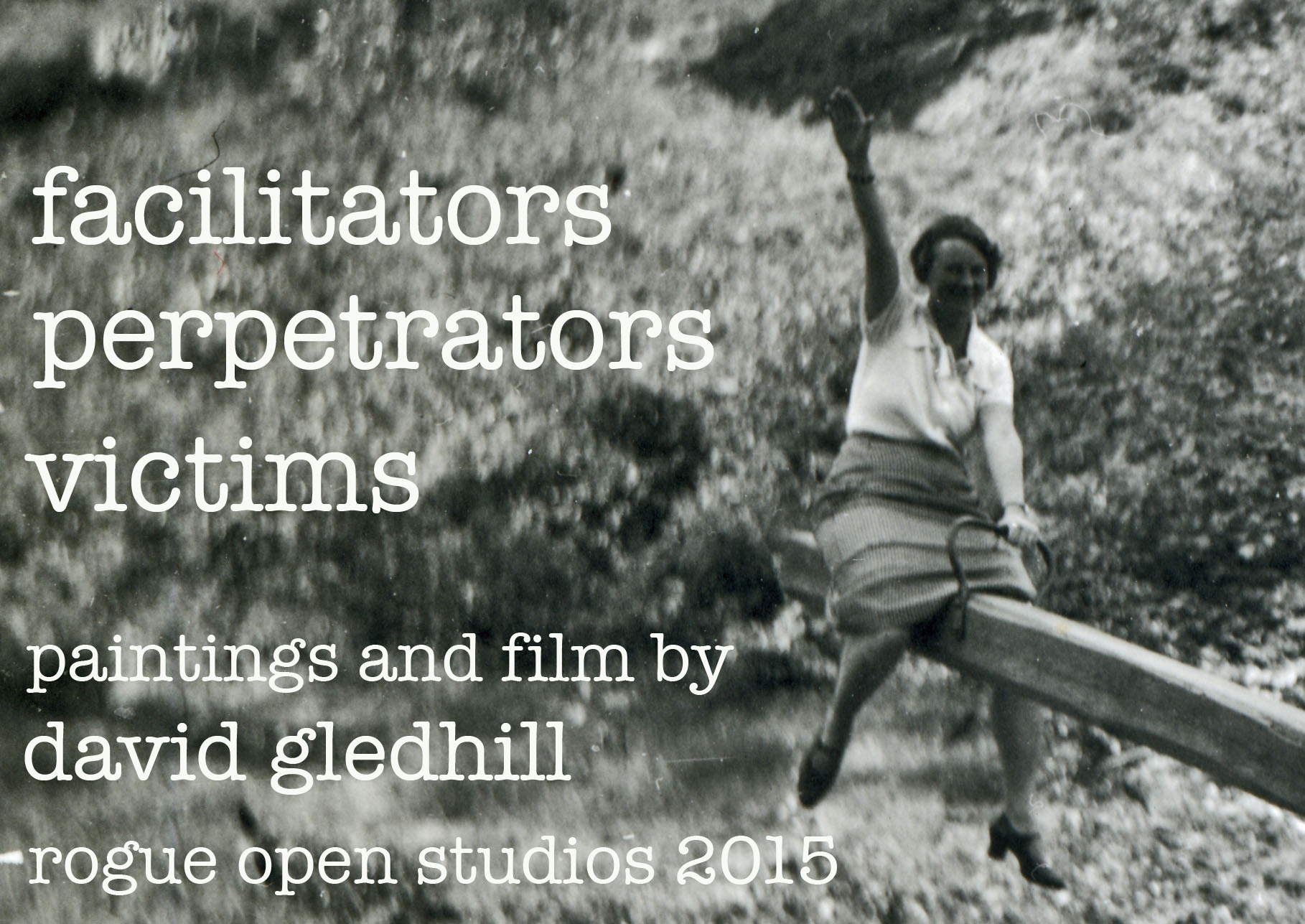
I’ll be exhibiting new paintings and film at this year’s Rogue Open Studios. All are welcome over the weekend of October 24th-25th. See you at the opening party on Friday October 23rd, 6-9pm if you can make it!
Rogue 20th Anniversary Open Studios October 24th-25th 2015
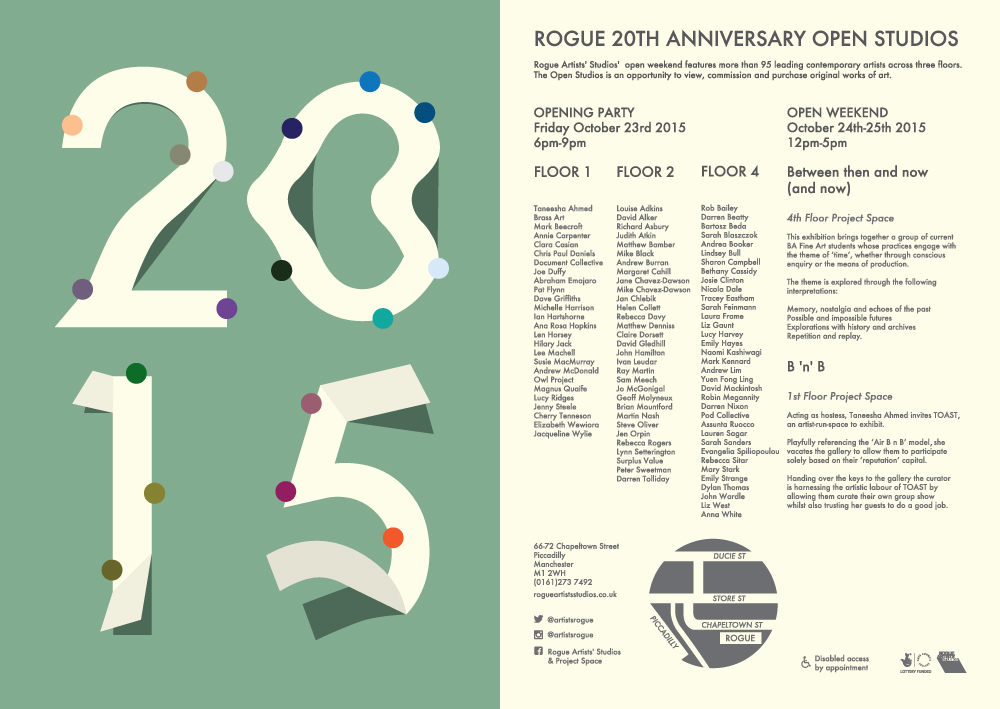
Everyone is welcome to Rogue Artists’ Studios’ 20th anniversary open weekend. The party is on Friday October 23rd, 6-9pm. The studios are open from 12-5pm Saturday 24th and Sunday 25th. We are just behind Piccadilly Railway Station in Manchester, UK.
Come and enjoy the work of more than 90 leading contemporary artists on 3 floors of historic Crusader Mill in the heart of Manchester. Entry is free and you can simply talk to the artists, view the work, buy or even commission something if you like!
Great building, great art. Don’t miss it!

Fabrications at Furniture Makers’ Hall, London.

Do Not Become What You See XI by Brian Reed
Fabrications July 4th to 11th.
Opening times: Sat to Tuesday 12-4pm by appointment only.
Email for further information: mikechavezdawson@yahoo.com.
Telephone: +44(0)7801 030290
It may be the case that artists have been engaging with specific sites, spaces and institutions for decades, but there are nevertheless relatively few instances of group shows that enter into a genuine thematic dialogue with their host venues. Since Marcel Duchamp suspended 1200 coal bags over a stove at the Exposition Internationale du Surrealisme in 1938, the potential to conceive of the space as integral to the work has accumulated an almost irresistible logic, making it seem retrograde to produce work that fits in anywhere. If, as Henri Lefebvre suggests in The Production of Space, artists can reinvest the real with utopian potential through the reappropriation of institutional spaces, then those interested in offering a critique, or indeed, a celebration of social and cultural phenomena seriously hamper themselves by sticking rigidly to the ‘white cube’ formula.
Duchamp’s spirit hovers over Fabrications, an exhibition in which Simon Attard, Mike Chavez-Dawson, Rosalind Davis and Brian Reed sustain a material, formal, aesthetic and utilitarian rapport with the modestly stately rooms of the Furniture Maker’s Hall at 12 Austin Friars in London. Chavez-Dawson has forensically researched every component of A Study For Above the Shoulders, sourcing the timber frame that supports a vintage 1940’s chrome light box from a defunct psychiatrist’s office. The result is an eerily disquieting meditation on the science of the creative mind, as manifested in a transparency featuring Rorschach prints of the names of artists who suffered from mental health problems. Herman Rorschach devised his inkblot test in 1921 as a means of diagnosing schizophrenia, and Chavez-Dawson’s work takes what Foucault called a ‘monologue by reason about madness’ and forces it into a confrontation with artistic free association. Rorschach inspired inkblot paintings punctuate the entire show, either clinically box-framed or available to browse on a sideboard that also offers ancient looking furniture catalogues. The opposing forces in this clash of modernist rationality with the mysteries of the unconscious mind exploded in the pre-war avant-gardes, and Duchamp, who claimed to be interested only in ‘man as a brain’ would surely have been delighted to encounter his infamous Fountain reconceived as a bespoke ring in this context. Duchamp’s Ring by Mike Chavez-Dawson, 2013 to 2017, is perfectly in keeping with the re-commodification of the lost ‘original’ urinal as a result of which it seems to pop up in most major public collections.
Kleckztale Chairs, a pair of Rorschach patterned 1940’s German cocktail chairs that enhance the consulting room ambience of the ground floor reception at Austin Friars, also provide a bridge to Rosalind Davis’ work. Davis’ paintings cite and improvise on a high modern repertoire of architectural and design forms, adding stitched geometries and broad washes of translucent pigment to conjure a set of complex interior spaces conveying something of the existential doubt that began to infect the modernist project during the post-war period. In the drawers of an elegant desk in the upstairs room, Davis has placed a series of altered photographic reproductions from Lesley Jackson’s Modern British Furniture. Stitched and painted across, these canonical tubular steel and leather chairs are pulled back from their pristine functionalism to a provisional status that simultaneously offers and questions the promise of a plan for living. The use of needlecraft in both the paintings and photographs reinfuses the angular severity of industrialised production methods with a comforting domesticity, reminding the viewer of the quite different principles that informed pre-modern design movements.
Entry Point, a steel and thread sculpture suspended in the stairwell, effortlessly achieves a harmony of materials, form and space and evokes approval of the modernist integration of art and life, but elsewhere in Fabrications there is more than enough black humour to suggest that the opposite view may be equally valid. Simon Attard’s paintings, enclosed in antique frames, borrow some of the existential angst of Francis Bacon’s work, re-situating cold war nihilism in a postmodern painterly flux where more or less anything can turn up on the canvas and still acquire weight and depth. Conceived as portraits, they mobilise the broadest range of painterly strategies in an understated commentary on painting both as a process and as a site of signification. Untitled, a small sombre-hued image of a skull is completely convincing as a Bacon, until you realise it’s an overpainted print of Damien Hirst’s For the Love of God. In a marvellously laconic gesture of solidarity, a trio of Attard’s portraits of Picasso, Bacon and Pollock incorporate Chavez-Dawson’s Rorschach’s made from these same artists names. Attard’s paintings take the form of an closely felt communion with his sources of inspiration, acknowledging their signature styles and gravitas without ever falling into pastiche or mockery. With these paintings, Attard realises Bacon’s imperative to ‘deepen the game’ with genuine subtlety.
The sense of shared preoccupations worked through without judgement, pulls together what may have seemed a particularly diverse set of artists and at first glance Brian Reed’s found photographs and text pieces appear at something of a tangent to the rest of the show. It becomes clear however, that Reed, like Davis has taken one of the founding technologies of the modern era and retooled it to release an entirely new set of meanings. Like Attard and Chavez-Dawson, Reed holds a productive dialogue with his sources, a set of banal but oddly poignant snapshots developed from discarded negatives, CD’s and passport photographs. These conventional validatory records have a curious finesse and iconic plenitude despite their dubious framing and inauspicious settings. Reed has developed, enlarged and mounted his finds on aluminium and many feature roughly drilled out faces, imbuing them with a blank uniformity entirely consonant with commercial mass manufacture. The absence of individuating features isolates the rituals, props and settings of our lives as a set of unfortunate compromises with industrial modernity and yet, in Do Not Become What You See XI, (pictured) Reed preserves the sitter for his blown-up passport photo intact. Subject, like all of us, to the rigid strictures of officialdom, she somehow preserves a spirit of ineffable optimism. Optimism also infuses the wooden text pieces. Excised from 1970s UNESCO policy documents, they memorialise the long last gasp of universal human rights while taking on a new contestatory resonance in austerity Britain.
Fabrications persuasively enlists its context in a sophisticated and cross-referenced commentary on the certainties of the modern era and the positivism that drove it ever onwards. It emerges from the encounter with a set of suggestions for further enquiry, suggestions that take account of the social, cultural and political breaches of the past, while providing a tentative sense of what may lie ahead.
‘Abordnung’ Paintings of Poland 1940-1941 by David Gledhill at Rogue Open Studios July 11-12th 2015
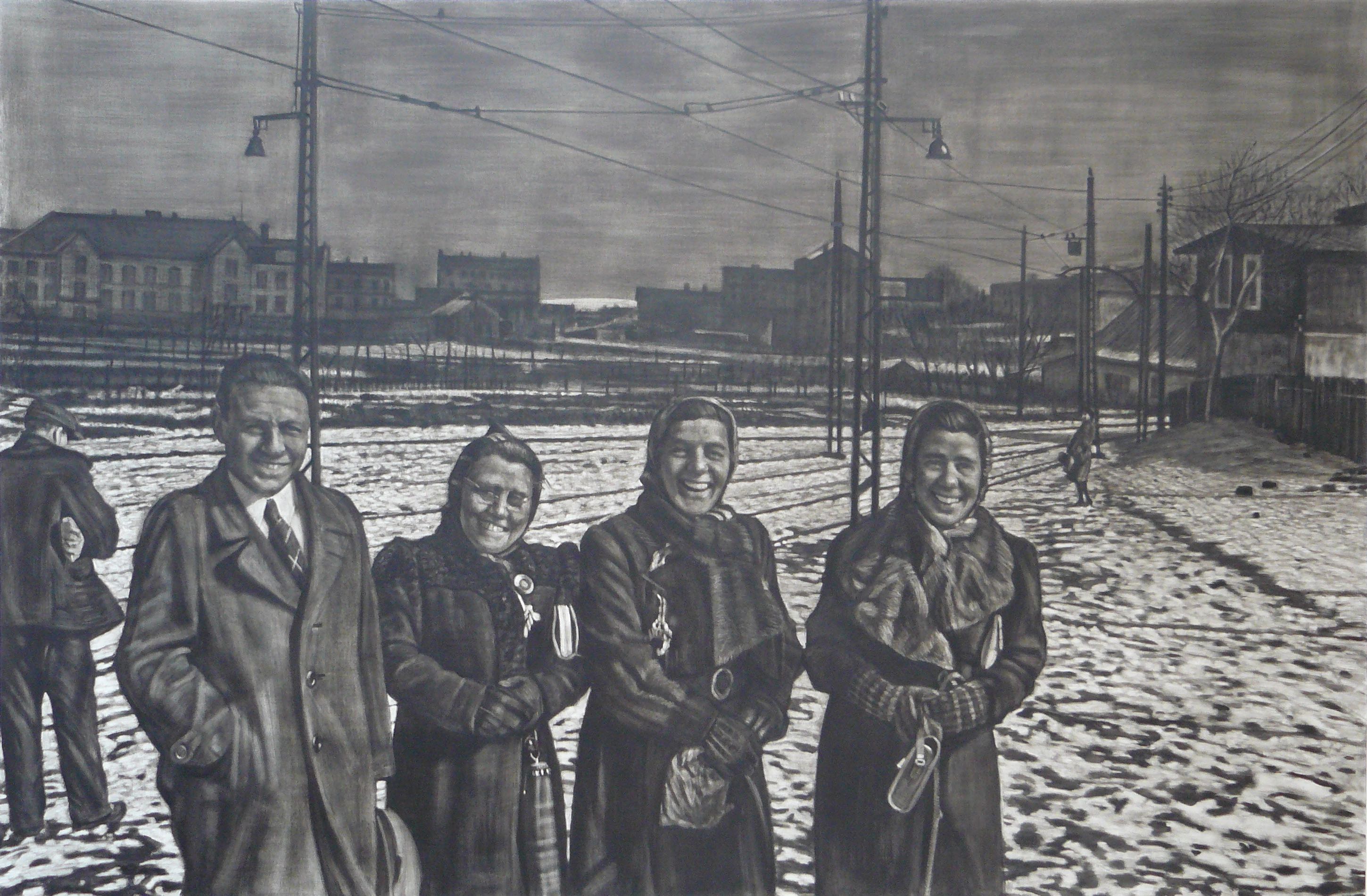
One of a series of paintings based on photographs in an album found in Frankfurt in 2013.
‘Abordnung’ features paintings from a series entitled ‘Poland 1940-1941’. The paintings are based on snapshots in an album discovered in a Frankfurt flea market in 2013. They appear to show a group of civilian administrators in Sosnowiec in Poland during the Second World War.
‘Abordnung’ will be part of the Manifest Arts Festival Rogue Open Studios over the weekend of July 11th and 12th 2015. See www.rogueartistsstudios.co.uk for details.

Collaborate! Oriel Sycarth Gallery, Glyndwr University, Wrexham. April 3 – June 19 2015
Collaborate!
Oriel Sycarth Gallery, Glyndwr University, Wrexham. April 3 – June 19 2015
Collaborate! is a compact and energised survey show that explores the range of collaborative practice in contemporary art. With its focus on the social relations of production in art across a broad spread of media and approaches, the exhibition is inevitably diverse with multiple divergent strands and tendencies. Work by veterans of co-operative production such as Judy Chicago and Tim Rollins and K.O.S., rubs against that of other high profile figures not normally associated with shared authorship such as abstract painter Bernard Frize. But it’s the emerging and less widely known artists that provide the substance here.
Perhaps the most immediately striking aspect of the show is that it works visually despite the drastic contrasts of high and low-tech media. The curators have accommodated the most eclectic assortment of video monitors, plinth and table-based pieces, standard wall mounted works, floor-based mixed media assemblages, live performance and projection. The continuous adjustment of posture and point of view that this profusion requires of the viewer encourages a sense of close physical engagement with both the individual exhibits, several of which can be interacted with, and also with the gallery space itself as a kind of pleasure arcade in which art recovers its sense of community.
Many of the exhibits take a particular cultural form as point of departure for works that subvert, expand or critique expectations. Julia Vogl’s team-built Dream Machine zoetrope offers a homemade optical fantasia that diffuses any trace of high seriousness, whilst Kristofer Henriksson and Kezia Pritchard’s blackened ‘At Night With You’ flick book is irresistible in this context. By contrast, Jeremy Hutchison’s unopenable notebook, displayed on steel shelving with other objects that wittily deny their own use value, paradoxically acquires enhanced exchange value as an art object in the process. Hutchison’s intervention in standardised commercial production is documented in fascinating emails between the artist and bewildered employees of the Wuyuan Julong Precision Tool Co. Ltd in China. Nina Rodin and Dennis de Caires’ ‘Cut Paintings’ project in which the artists attempted to produce an edition of 10 identical books from a sequence of jointly executed paintings on paper, repeatedly replays a familiar repertoire of brushy improvisations in an interrogation of the singularity of the painterly gesture. The book form provides a link across to the video work via R. Lyon and Jessie Stead’s videotaped recital of an interminable and bizarre text message exchange. ‘Duh Angel’ obfuscates rather than clarifies their relationship and the accompanying book is equally unilluminating, but effectively blurs the transparency of language in an age of multiple urban linguistic codes.
The tension between the book as mass-produced material artefact and the unexpectedly sensuous immediacy of ‘Cut Paintings’ is inverted in Cornford and Cross’s ‘Afterimage III’, which consists of four framed aluminium photo mounts from which the photographs have been torn. What would have distinguished each of the panels has been discarded and we are left with pristine blankness and uniformity. The texts that accompany each of their contributions, integrate the cultural references that inform Cornford and Cross’s work with the presentation of the objects themselves, each of which preserves an eloquent semantic silence. From this vantage point at the start of the show, brute materiality emerges as another subtheme. A jumble of propped paintings, gaffer tape, brightly coloured detritus and postcards from Tate Britain painted out except for the flesh passages, is overlooked by a suspended yoga ball. ‘Pretty Peeved’ along with its neighbouring construction by Sarah Pettitt and Robert Rivers, sprawls across the middle of the gallery insisting on clutter as a valid compositional idiom. Nina Rodin and Rebecca Molloy have managed to enact a deconstruction of the formal, aesthetic and technical resources of painting whilst reminding us that collaboration can be fun as well as challenging. Nicholas John Jones’ abstract canvas, propped alongside Nina’s simultaneously produced copy of it, signals a new kind of reflexivity about painting as a social enterprise. This aspect of the exhibition is expanded upon in Ivan Liotchev’s gigantic ‘Drawing No 9’ that constitutes an equally exuberant and compendious meditation on communal authorship, involving contributions from 400 participants in his International Collaborative Drawing Project. Its hectic agglomeration of cartoon images, abstract flourishes and fragments of landscape sets up a new iconic democracy that detonates the myth of the marginalised and solitary painter.
Collaborate! includes artists who habitually work in collectives or partnerships but there are also a number of individuals that facilitate or coordinate others through research driven strategies that rebalance the traditional artist/subject dynamic. Helen Knowles’s highly plausible performance piece, during which an algorithm is tried for murder, involved professional lawyers, an actor and a unique computer, hand-built by artist Daniel Dressel, that was found innocent by the guest jury at the opening night. It manages to be drily humorous and disquieting at the same time. Phoebe Davies’ ‘Act 1: Astoria’ celebrates spirited old age in a video that hands a degree of authorship over to the regulars of two day care centres, whilst in ‘Welcome to Sherry #37’, Ann Liv Young’s on-screen persona lambasts the shallow young things of New York’s Soho district for their LGBT intolerant attitudes and lack of social engagement. Young works with her partner Michael A. Guerrero, whose monosyllabic responses to her rant reverse interview protocols.
Elsewhere in the show, video artists working with other artists as subjects demonstrate that the camera as prosthetic eye need not frame the power relations at play in the work. ‘The Future of Marriage’ by Jeremy Bailey with Kristen Schaffer puns on this powerplay in Schaffer’s subjection to a digital unicorn head, behind which she performs karaoke renditions of hit tunes. Perhaps the most impressive meditation on the nature of the artist-artist partnership is Nastja Säde Rönkkö and Ernest Truly’s ‘From City of Love’ performance in which the pair sustained a continuous kiss in the gallery for 2 hours while enjoying the audience’s choice of music on their iphones. The collective Weast’s ‘The Relation between opposing principles or forces or factors’ features Murakami Hiroshi and Tanaka Ryo in a series of surreal street tussles and rituals, and Biters’ (Larry Achiampong and David Blandy) ‘Hats of Raw’ appropriates all manner of musical content into a genuinely decentred celebration of popular culture. Both works dissolve any sense of the artists’ direct agency in a welter of samples, quotations and theatrical misdirection.
The curatorial challenge implicit in Collaborate! would seem to have been one of integrating the most diverse group of artists working across a potentially centrifugal range of issues, with only the socialised basis of their various projects providing any common ground. The abundant correspondences and dialogues activated by the show demonstrate that this challenge has been met and that collaborative practice has become a tactic of choice for artists wanting to break out of market dictated constraints and sanctions. Collaborate! reminds the viewer that every aspect of the conception, fabrication, distribution and display of contemporary art is continually being challenged and reassessed. Beyond that it invites us to engage with a panorama of possibilities and creative partnerships in which the insistence on individual artistic provenance has become irrelevant.
David Gledhill

Nastja Säde Rönkkö and Ernest Truly’s performance of ‘From City of Love’ at Collaborate!
‘Album’ at the Holden Gallery Café, Manchester School of Art February 2015.

‘Hankering for Classification’ at Toast, Federation House, Manchester.

Head to Head

I’m looking forward to taking part in the closing panel discussion for this terrific show that started its tour at the Rogue Project Space and inspired some fascinating debate around contemporary painting. Thanks to Nicholas Jones and Ivan Liotchev for inviting me!

